
BARGAINING 2025: WHAT YOU NEED TO KNOW
The FSA and BCIT management have commenced negotiations for our twentieth Collective Agreement (CA). Whether this is your first experience with collective bargaining at BCIT or you’re a long-serving member in need of a refresher, this page will provide a crash course on our bargaining process.
We’re treating this page as a living document, so please keep your questions coming! Contact the FSA through your Member Engagement Officer: [email protected].
As FSA members, the terms and conditions of your employment are governed by the CA between the FSA--your certified bargaining agent--and the Institute, with oversight from the province’s Post-Secondary Employers’ Association (PSEA).
This legally binding document outlines numerous aspects of your employment, including departmental and managerial hiring procedures, salary, benefits, and vacation entitlements—to list just a few items. The CA also codifies the definition and scope of collegial governance.
Our CA is periodically renegotiated by the FSA’s Bargaining Team and BCIT management, under legal conditions specified in BC’s Labour Relations Code. The current CA expired on June 30, 2025, and bargaining teams representing both parties began negotiating a new contract in early October 2025.
As part of the bargaining process, each party comes to the table with a set of proposals for changes that they would like to see in the next CA. These changes can be additions, deletions, or tweaks to existing articles. Generally speaking, the parties negotiate by presenting a series of proposals and counterproposals until they reach a tentative agreement that both teams accept. The eventual tentative agreement does not become official until both parties have ratified it. You and your FSA colleagues will have the opportunity to vote to ratify the tentative agreement. On the other side, members of BCIT’s Board of Governors will have a separate ratification vote.
In BC, the public-sector bargaining process is somewhat more complicated than elsewhere in Canada. Here, the provincial government interferes in the usual employer-bargaining agent (union) bargaining relationship through its Public Sector Employers’ Council (PSEC), which sets economic terms of negotiations, known as bargaining mandates, for public-sector employers like BCIT. PSEC is also a signatory to our CA through the PSEA.
The FSA’s Bargaining Team is currently finalizing its bargaining proposals, drawing on several sources:
- The results of the 2024 bargaining survey
- Recommendations from the Collective Agreement Committee (CAC)
- Consultations with FSA departments, Tech Reps, and individual members
- Input from the FSA Board of Directors and staff
- Sectoral research and comparative analysis
In January 2025, the FSA membership formally endorsed the primary bargaining theme: Making Life Better, supported by the sub-themes of:
- Lifting Each Other Up
- Benefits Improvements
- Workload Matters, and
- Untangling the Knots
This mandate reflects clear member priorities: improved working conditions, enhanced benefits, greater support for work-life balance, and strengthened educational environments. These goals will shape the FSA’s approach at the bargaining table.
During collective bargaining, you should expect some give-and-take. Our Bargaining Team will not achieve every proposal they present to management, but they will have worked very hard for an agreement that:
- Consolidates previous gains
- Enhances working conditions
- Improves benefits
- Advances Indigenization initiatives
- Protects member rights
Collective bargaining is an iterative and cumulative process. Since the first agreement in 1975, the FSA has consistently worked to strengthen the CA and to safeguard hard-won improvements.
Your FSA Bargaining Team for round 20 is:
- Colin Jones – FSA President and Chief Negotiator
- Trish Albino – Faculty, School of Business + Media (SOB+M), FSA Treasurer
- Thomas Lane – Faculty, School of Computing and Academic Studies (SOCAS)
- Judy Shandler – Part-Time Studies Faculty, School of Energy (SOE-PTS), FSA Board member
- Kenzie Woodbridge – Information Technology Services (ITS)
- Doug Thorpe-Dorward – Executive Director, Ex-officio
- Maria Angerilli – Associate Executive Director, Bargaining Support
Approved by the FSA Board of Directors in April 2025, this team represents a broad cross-section of the FSA membership. The Bargaining Team is responsible for conducting formal negotiations with BCIT management, presenting the proposals developed through member consultation, and evaluating counterproposals from the employer.
At present, the individuals representing BCIT management (and, by extension, the provincial government) in our contract negotiations are:
- Michael Madill – Lead Spokesperson
- Kiren Gill – Manager, Labour Relations
- Sarah Cohen – Labour Relations Consultant
- Omair Quraishi – Associate Vice President, Digital Transformation & Chief Information Officer
- Kathryn Kennedy – Associate Dean, School of Health Sciences
- Eric Fry – Associate Dean, Agile and Work-Integrated Learning
- Phil Ramer – Associate Dean, School of Business + Media
- Janelle Caballero – Note taker
Once either party serves notice to bargain, both bargaining teams, representing the union and the employer, are legally obligated to engage in good-faith negotiations and make reasonable efforts to reach a new agreement. The FSA provided Notice to Commence Bargaining to the employer on June 17, 2025—two weeks in advance of our current CA’s expiration.
The fact that our CA has expired doesn’t change the terms of your work. Until a new agreement is ratified, the provisions of the previous contract remain in effect, including salary, professional development funding, and benefits.
In the event of strike or lockout, the employer may, however, decide to alter the terms of the CA. Yet, the FSA is very well positioned to oppose any such changes—especially since joining the CAUT Defence Fund, explained in the next question.
As illustrated in the flowchart below, collective bargaining follows a multi-step process. In recent rounds, the negotiation of a new CA has typically concluded in approximately one year, involving around 15 to 20 meetings between the respective bargaining teams.
During the most recent round, bargaining began in late September 2022, following the expiration of the previous agreement on June 30, 2022. A tentative agreement was reached in June 2023 and subsequently presented to the membership for ratification, which occurred in July 2023.
Despite successful ratification, the employer took an inordinate amount of time to issue retroactive pay to members—an issue that remained under discussion into early 2024. The FSA is hopeful that such delays will not be repeated after the twentieth round of bargaining concludes.
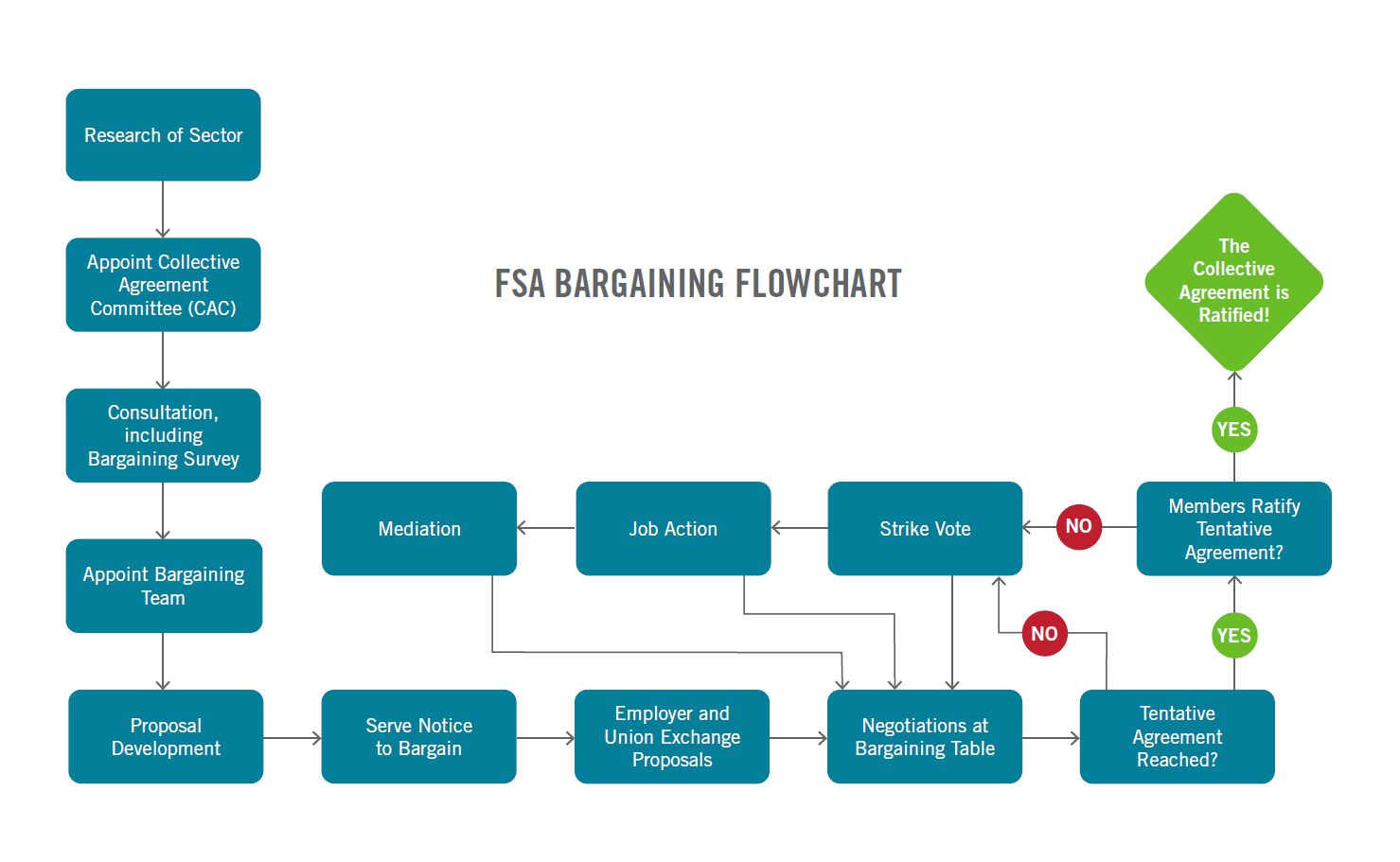
Although it has not happened recently for our members, negotiations with the employer may reach impasse—meaning that the bargaining teams are unable to agree on a tentative agreement. In such cases, union members may hold a strike vote to authorize potential job action. While this vote does not mandate job action, it provides the legal basis for any union action to commence 72 hours after notice is filed with the provincial Labour Relations Board. Recent work by FSA affiliates and other post-secondary unions has also demonstrated how motivating a successful strike vote can be for an employer.
The employer may also call for a lockout of the bargaining unit employees, which happened at Halifax’s Dalhousie University in Summer 2025.
The responsibility for coordinating job action lies with the Job Action Committee (JAC), which operates under the direction of the FSA Board of Directors or their designate. The JAC is the strategic arm behind any such activities.
FSA members were last engaged in strike action between mid-November and early December 2012. During that period, members undertook picketing and other forms of job action. Since then, member engagement and organizational preparedness have significantly increased. Committees such as the JAC and the Bargaining Communications Committee (BCC) provide enhanced support to the Bargaining Team and facilitate better member activity.
The FSA held in its strike accounts north of $3.2 million at the end of the 2023-24 fiscal year. Buttressing our already impressive coffers, the FSA joined the CAUT Defence Fund in Spring 2024, which provides our union access to the Fund’s more than $40 million in strike support money. The CAUT Defence Fund may supply:
- Daily Strike Benefits: Financial support for union members during strikes, lockouts, or rotating strikes.
- Strike Support Loans: Assistance for extraordinary expenses related to strike preparation or participation.
- Group Benefit Loans: Coverage of group insurance premiums during a strike.
- Strike Mediation/Arbitration Support: Funding for mediation or arbitration to resolve strikes or lockouts.
- Negotiation Mediation/Arbitration Support: Assistance with mediation or arbitration costs during collective bargaining.
- Bargaining Rights Defence: Support for legal costs in defending bargaining rights, including unfair labour practice claims or challenges to collective bargaining/strike rights.
- Strike Support Actions: Support for demonstrations or other solidarity actions to help resolve a strike.
With this bargaining infrastructure in place, the FSA is well-positioned to achieve our overarching bargaining objective: to make life and education better at BCIT.
The guidance we’ve received from experts in benefits bargaining is that health care spending accounts generally provide much less overall value than our current system of itemized benefits. This is probably why employers tend to like them. In particular, members who make more claims than the average could end up at a significant disadvantage and paying out of pocket for services that would otherwise have been covered.
It is essential that all FSA members remain well-informed throughout the bargaining process for the twentieth CA. The BCC will issue regular Bargaining Dispatches, posted in the Bargaining Updates section of the FSA website. These updates will also be included in the FSA’s Weekly E-Bulletin, delivered to your inbox every Friday from September through June (excluding the winter break). If urgent developments arise, the BCC will communicate outside of the standard Weekly E-Bulletin schedule.
Communication will be guided by the FSA and BCIT’s established bargaining protocols, which define what information may be shared publicly and with our members. Regardless of the protocols, the BCC remains committed to issuing timely, transparent, and informative updates throughout the bargaining process.
Clear communication between the FSA Board, the membership, the Bargaining Team, the JAC, and the BCC are a key focus of the FSA’s elected representatives, committee appointees, and staff during the bargaining process. Nevertheless, if you feel that your questions are left unanswered, or you’re frustrated by not being able to get access to specific information, please avoid relying on speculation and instead reach out to us your Member Engagement Officer Matt Greaves ([email protected]) with questions.